
Umberto Eco’s The Name of the Rose is a literary phenomenon with a mysterious cultural appeal. How did this philosophically dense, 500+ page novel about medieval monks sell fifty million copies? We would need a detective as skilled as the novel’s protagonist, William of Baskerville, to solve the mystery.
Continue reading “A Novel By Any Other Name: Reflections on The Name of the Rose”Between Satire and Tragedy: Troilus and Cressida
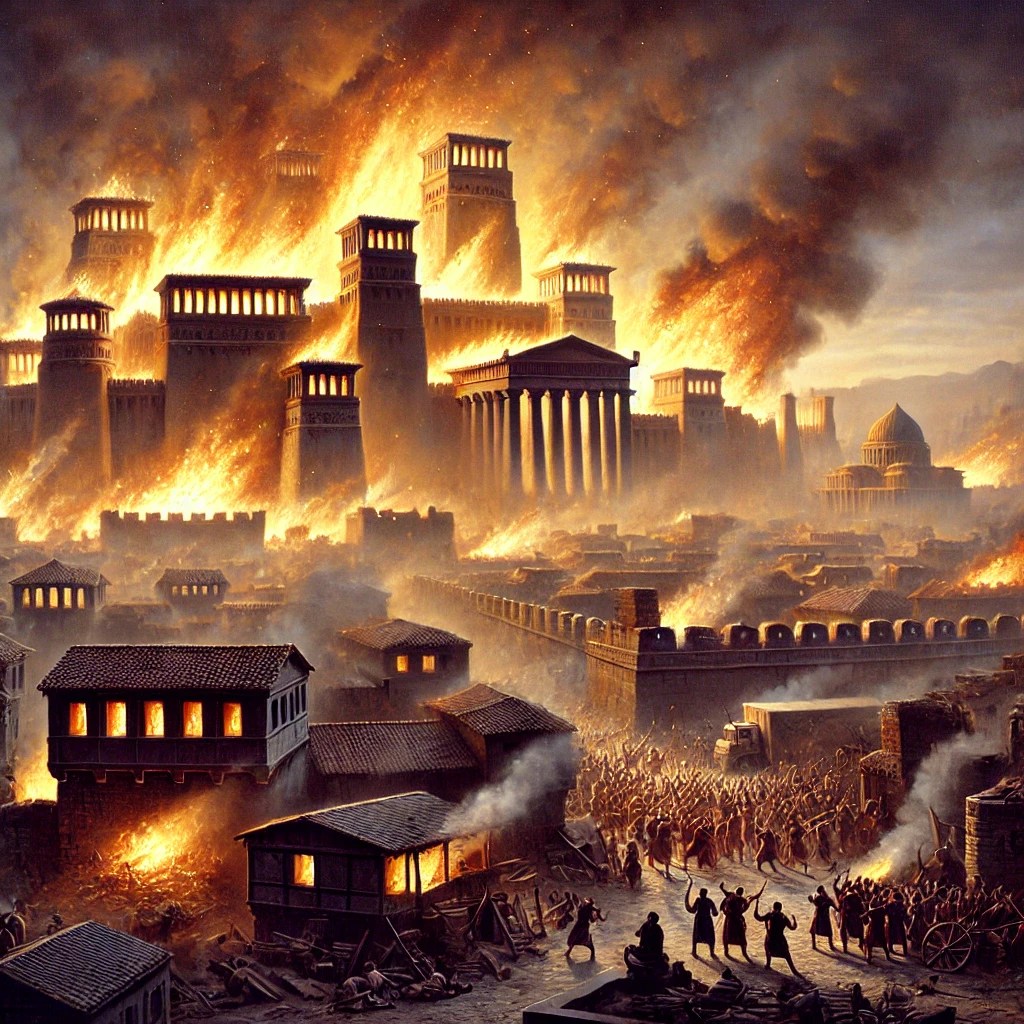
In Troilus and Cressida (1602), Shakespeare presents familiar characters in an unfamiliar way. This problem play takes Homer’s epic heroes–Achilles, Ajax, Hector, Ulysses–and represents them as a pale simulacrum of their reputations. The main plot, the failed love story between Troilus and Cressida, reinforces this satirical presentation of pagan heroism.
Continue reading “Between Satire and Tragedy: Troilus and Cressida”The Cynical Spy Out in the Ethical Cold

By exploring a world where deception is currency and loyalty is a luxury, The Spy Who Came In From the Cold (1963) forced its readers to confront uncomfortable truths about the morality of the Cold War. More than sixty years after its publication, the novel retains its power.
Continue reading “The Cynical Spy Out in the Ethical Cold”Problematic Grace, Problematic Mercy

Shakespeare’s Measure for Measure is the third in his series of problem plays, following Troilus and Cressida and All’s Well That Ends Well (which I wrote about here). Written at the turn of the 17th century, MFM is steeped in Christian themes and allusions, most notably in its title, which references Matthew 7:2: “For in the same way you judge others, you will be judged, and with the measure you use, it will be measured to you.”
Continue reading “Problematic Grace, Problematic Mercy”All’s Well That Ends Well: Shakespearean Comedic Providence and Redemption
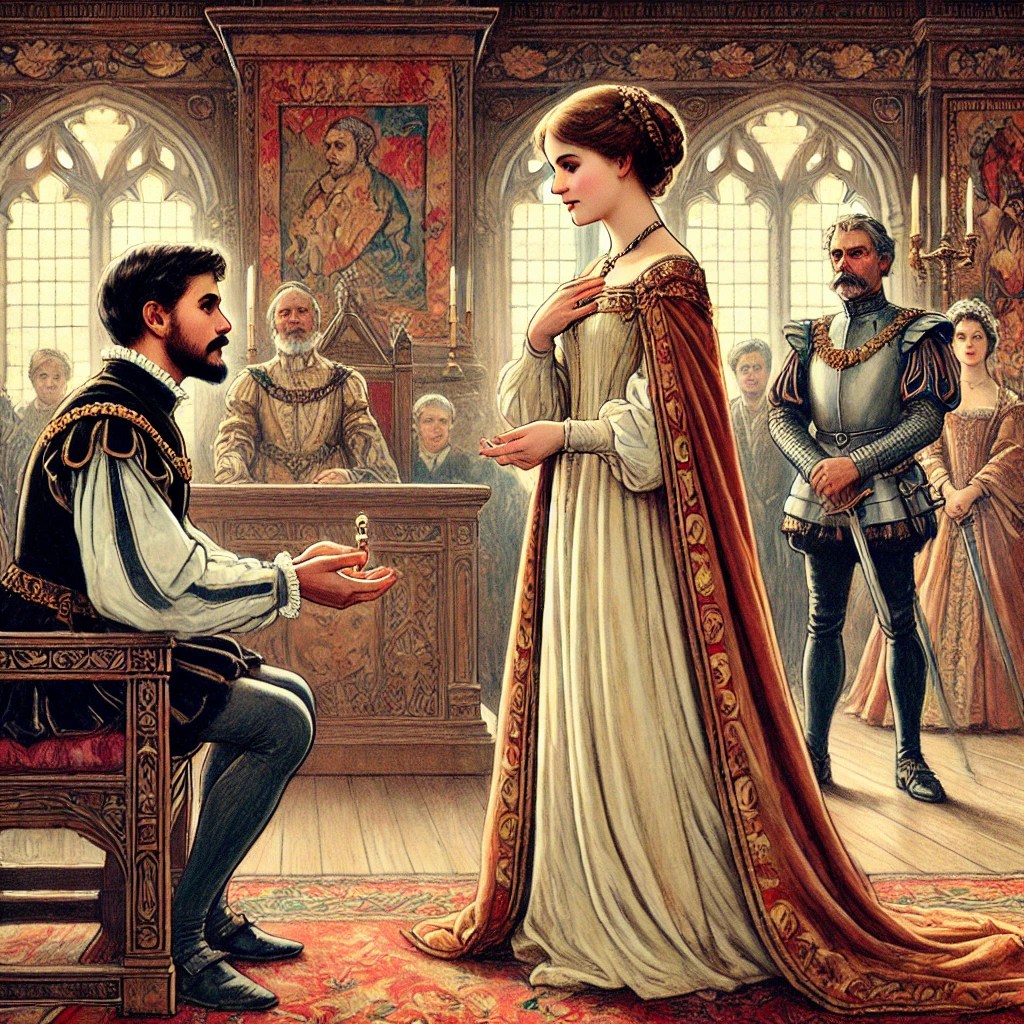
Often labeled a problem comedy, William Shakespeare’s All’s Well That Ends Well weaves together strands of love, deception, and redemption to explore the tension between natural and spiritual interpretations of the world. The playgoer should leave the theater considering the role of divine providence in human affairs, and because it’s a comedy, the audience member’s focus should be on the way providence brings about a happy ending.
Continue reading “All’s Well That Ends Well: Shakespearean Comedic Providence and Redemption”Persuasive Judgment in Jane Austen’s Persuasion
Jane Austen’s novel Persuasion explores the relationship between judgment–the capacity to form opinions based on reason, understanding, and intuition–and persuasion, convincing others to consider or accept one’s point of view. Austen takes a fairy-tale structure–the forsaken daughter who finds love–and imbues it with persuasive pathos by complementing the plot with irony-tinged commentary on a small set of characters. The fairy tale has a happy ending, but we’re meant to see more than Anne and Captain Wentworth’s marriage. The novel has very little external action. Instead, it gains its drama from how characters judge one another and the tension that comes from whether or not they will be persuaded by the good or bad judgment of others. In the end, the novel demonstrates that good judgments are ethical, not social, and persuasion should be judged by intent, not outcome.
The trio of Lady Elliot, Lady Russell, and Anne Elliot represent good judgment in the novel. They demonstrate emotional concern for others, exhibit that emotional concern through concrete behavior, and take responsibility for the consequences of those judgments. Lady Elliot, Anne’s late mother, exhibits “judgement and conduct…without indulgence.” The connection between judgment and conduct is crucial. Good evaluation is inextricable from good actions. It is, of course, Anne who elicits Lady Russell’s most favorable judgment: “only in Anne that she could fancy the mother to revive again.” Anne earns Lady Russell’s approbation because she exhibits the same good judgment and conduct as her mother. Lady Russell’s superior evaluation of people is something appreciated by Anne as well as the family attorney Mr. Shepherd. The narrator comments that Shepherd appeals to Lady Russell’s “known good sense…to have just such resolute measures advised as he meant to see finally adopted.” Anne listens to Lady Russell because of this reputation combined with her obvious affection for Anne’s mother and, by extension, Anne herself.
The list of characters with poor judgment is long. Anne’s father and sisters are too selfish to exhibit good judgment. They feel only their own slights and act according to what would be best for them. Consequently, they evaluate everything and everyone poorly. Walter Elliott can’t tell whose good or bad because all he can see is someone’s superficial social position. Elizabeth falls for Mrs. Clay’s sycophancy. Mary misreads her husband, children, and anyone connected to her family. There is little wonder why Anne relies on Lady Russell’s judgment in the absence of her mother. No one inside her family can make good decisions for themselves, much less someone else.
The novel’s chief theme, of course, is persuasion, and judgment plays a part in someone’s power to persuade and susceptibility to persuasion. At its best, this cycle of judgment and persuasion happens internally. Anne weighs the evidence of Mr. Elliott, her cousin, and finds that although he seems to have good judgment, “she would have been afraid to answer for his conduct.” Her judgment eventually comes down to her assessment of Mr. Elliot as a person: “she could not be satisfied that she really knew his character.” Without that knowledge, she persuades herself not to give him her affections.
Yet, she finds Lady Russell’s judgment potentially persuading. After learning the truth about Mr. Elliot from her friend Mrs. Smith, Anne reflects, “It was just possible that she might have been persuaded by Lady Russell!” Just as Lady Russell unwisely judged Captain Wentworth wanting, she unwisely judged Mr. Elliot as a suitable mate for Anne. Here we find a complication. Someone may exhibit good judgment in particular arenas and have an area of weakness. Lady Russell’s weakness appears to be in the area of determining Anne’s best romantic match. Ironically, her personal care for Anne may play a part in her poor judgment.
The novel’s action is largely internal, and one thing Anne must come to peace in her own heart and mind with what led her to break off her engagement with Captain Wentworth. She bowed to Lady Russell’s persuasive judgment against her own wishes. Yet, despite the heartache it brought her, she believes it was a correct decision driven by duty, which elucidates how judgment is a function of one’s conscience: “I have been thinking over the past, and trying impartially to judge of the right and wrong, I mean with regard to myself; and I must believe that I was right, much as I suffered from it, that I was perfectly right in being guided by the friend whom you will love better than you do now.” Though Anne regrets the outcome, her decision meets her criterion of judgment. It was an ethical decision to obey Lady Russell as she would a parent. This wisdom in evaluating the nature of her persuadability is a persuasive testament to her maturity and strength of character.
Austen’s Persuasion offers a rich study of how judgment and persuasion can intersect and influence each other, inviting us to reflect on how closely intertwined good character and good judgment are
Judgment in The Tempest
Shakespeare’s final play, The Tempest, revisits the same motifs of judgment and punishment present in his tragedies. However, he depicts them in a redemptive rather than vindictive light. Through characters such as Prospero, Ariel, Caliban, and Ferdinand, Shakespeare connects judgment with responsibility and the play’s ethical presuppositions with the willingness to forgive.
The character Prospero serves as the play’s central figure of authority and judgment. He is a deposed Duke who was punished through exile for giving his political responsibilities to his brother Antonio. While an exile, Prospero has planned to judge his brother for this wrong and intends to use magic. Magic is an odd means of judgment, however. It entails hidden knowledge, something someone can only master after time. It also implies the power to do good. Look at how Prospero talks about freeing his servant Ariel from the power of Sycorax: “It was a torment / To lay upon the damn’d, which Sycorax / Could not again undo.” Prospero knows Sycorax’s punishment was harsh because he has the power for such punishment; he also has the power to heal, as it was his power that set Ariel free. Early in the play then, the dichotomy is set before Prospero. Will he use his magic for harm or redemption?
Prospero is willing to use magic to punish in his interactions with the enslaved Caliban, who is often at the receiving end of Prospero’s wrath. The judgment of Prospero and the consequent punishment meted out to Caliban are summarized in the lines, “Thou most lying slave, / Whom stripes may move, not kindness!” and “therefore wast thou / Deservedly confined into this rock, / Who hadst deserved more than a prison.” These lines highlight the punitive approach Prospero takes with Caliban. Judgment requires the responsibility to mete out justice. Prospero here does not give any slack to Caliban after he attacks Miranda.
The act of forgiveness plays a vital role in Prospero’s judgment. In the play’s final act, he acknowledges his responsibility to Caliban. “This thing of darkness, I acknowledge mine.” Of course, Caliban immediately fears reprisals: “I shall be pinched to death.” Instead, Prospero demands that Caliban clean his quarters, and he will receive a “pardon.” Finally, Prospero deals with the central problem in his life: how to deal with his brother’s betrayal. Ultimately, with the bidding of Ariel, Prospero chooses to forgive those who have wronged him: “Though with their high wrongs I am struck to the quick, / Yet with my nobler reason ‘gaitist my fury / Do I take part: the rarer action is / In virtue than in vengeance: they being penitent, / The sole drift of my purpose doth extend / Not a frown further.” These lines show that Prospero uses his ability to judge to punish and forgive, signifying a profound understanding of the human condition and the power of compassion.
Shakespeare intertwines the theme of judgment and punishment with the symbolism of garments, which appear as external markers of authority. Antonio, Prospero’s brother, remarks, “How well my garments sit upon me; Much feater than before: my brother’s servants / Were then my fellows; now they are my men.” Of course, Antonio’s close fit well because of Prospero. Antonio got his power illegitimately in Milan, and even now, his clothes fit and bear no sign of the storm because of Prospero’s magic. On the other hand, Prospero has a mantle that reinforces the connection between appearance, authority, and the power to judge. When he unleashes the storm on his brother Antonio and his men, he does so while donning his “magic garment.” This clothing acts as an outward manifestation of Prospero’s power to judge and execute punishment. It’s important to note that while Prospero forsakes his book and breaks his staff, he does not mention abandoning his robe. Now that he’s offered a judgment on his brother–a forgiving one–and is returning home as Duke, he will keep the robe of judgment and won’t use magic to perform that role. He only needs experience.
The difference between this play and a tragedy like King Lear is worth considering. After losing his kingdom due to poor judgment, Lear is a poor wretch without his kingly attire trapped in the wind and rain. In that play, the forgiveness comes from Cordelia, who forgives her father for his lack of proper judgment. However, the consequences for both Lear and Cordelia are dire. They lose their lives at the hands of those in power. Cordelia can forgive her father, but she cannot save herself. Lear can reconcile with Cordelia, but he cannot regain his kingdom. In The Tempest, Prospero forgives, leaves the island, and arranges for a marriage between his daughter and the son of another nobleman. The play’s emphasis is less on vengeance than redemption.
In conclusion, “The Tempest” presents a differently shaded discourse on judgment and punishment than he does in a play like King Lear. Through the characters’ interactions, Shakespeare explores the inherent power dynamics and moral dilemmas involved in judging and meting out punishment. Through this exploration, we are reminded of the complexity and responsibility that comes with wielding power and the critical role that compassion plays in judgment.
By What Standard? Judgment in Frankenstein
Mary Shelley’s Frankenstein, or the Modern Prometheus asks readers to wrestle with perplexing questions about the nature of monstrosity and justice. These are ethical concerns. Who gets to say that the monster is more or less monstrous than the man who made him? Is it Frankenstein or his creation that is the novel’s true hero? Shelley does more than dramatize poor judgment. She asks her readers to examine their judgment, which is unavoidably theological.
The novel’s title character, Frankenstein, displays a shocking lack of self-awareness. He tells Walton, “I possessed a coolness of judgment that fitted me for illustrious achievements. This sentiment of the worth of my nature supported me when others would have been oppressed.” This self-perception contrasts starkly with his poor judgment throughout the novel. He indulges his selfish desires, succumbs to intense mood swings, and shirks from the responsibilities of caring for the creature he has made. His inability to make a selfless sacrifice or display genuine repentance lays bare the ironic dissonance between his self-judgment and reality.
Curiously, Frankenstein’s skewed self-perception finds a receptive audience in the story’s narrator Walton who evaluates Frankenstein this way: “an intuitive discernment, a quick but never-failing power of judgment, a penetration into the causes of things, unequalled for clearness and precision.” This admiration may be reflective of Walton’s flawed judgment. As the narrator of the novel’s frame, Walton identifies with Frankenstein, seeing a peer in him—another adventurer chasing fame through a perilous journey into the unknown.
In stark contrast to the tragic duo of Walton and Frankenstein, the monster’s pleas for understanding illuminate a different aspect of judgment—compassion. He asks his creator, “Listen to my tale; when you have heard that, abandon or commiserate me, as you shall judge that I deserve,” hinting at his yearning for justice and humanity. This longing is further exemplified in the monster’s interaction with the blind man, whose acceptance of him, based solely on his words, serves as a poignant reminder of judgment devoid of visual bias. Regrettably, such compassionate judgment eludes Frankenstein..
Through diverse characters and circumstances, Shelley underscores judgment’s necessity and profound consequences. It is something Walton, Frankenstein, and the monster cannot avoid. Neither, too, can the reader, who must ethically judge the characters in the novel by some standard. The monster reads history (Plutarch) and poetry (Milton) but never scripture. Frankenstein likewise submits himself to the moral judgment of the universe rather than the revealed scripture of the Bible. This is shocking in a novel that continually alludes to Paradise Lost, an epic version of the fall. Shelley is not pointing us back to God, but without the God of the Bible, we can’t render the judgments that make her novel powerful.
Seeds of Sin and Salvation: The Biblical Resonances of Plant Imagery in Macbeth
A lesser-explored element of Macbeth’s imagery, plants are a recurring motif in Shakespeare’s tragedy. Viewed through a biblical lens, the play’s flowers and forests are metaphors for growth, deception, power, destiny, and downfall.
The first mention of seeds and plants in the play comes from Banquo who connects them with the witches. He says, “If you can look into the seeds of time, / And say which grain will grow and which will not, / Speak then to me.” Banquo looks to the wtiches for definitive judgment. The power to predict what happens with a seed equals the power to predict the future. Of course, both Macbeth and Banquo receive prophecies. One turns out more like a tree, the other more like a thorn. The fascination with definitive judgment and an impatience to know the fulfill the future’s promise looms over the entire play. The pertinent biblical passage comes from Galatians, where Paul gives a causal argument for how the righteous prosper: “Do not be deceived: God cannot be mocked. A man reaps what he sows.” This is surely true of Macbeth.
When King Duncan first sees Macbeth, he describes their relationship as a gardener and a plant: “I have begun to plant thee, and will labour / To make thee full of growing.” Duncan takes the responsibility of cultivating Macbeth’s power. He wants to see Macbeth reach his potential. A tree, of course, is a source of protection and shade. At this point, Macbeth has already protected Duncan from rebels. But Duncan’s line could point to Macbeth’s youth. The pertinent biblical passage here is Psalm 1:3 which talks about the righteous man as a flourishing tree: “He is like a tree planted by streams of water, which yields its fruit in season and whose leaf does not wither– whatever he does prospers.” Though Macbeth is an accomplished warrior, he may not have reached full maturity in his leadership ability. Duncan pledges to help Macbeth flourish.
When Lady Macbeth urges her husband to kill Duncan, she uses imagery from Genesis: “Look like the innocent flower, / But be the serpent under.” The simile is particularly potent because it collapses the tempter and tempted. Macbeth is like Adam falling into temptation, but Lady Macbeth wants him to imagine that he’s the deceiving serpent.
Of course, the most famous tree imagery in the play involves Birnam Wood. The apparition in Act 4 holds a tree in its hand, and Macbeth hears that he will be king until Birnam Wood moves to Dunsinaine. The link between Macbeth’s fate and nature signals that his downfall will directly result from his sin. In his arrogance, Macbeth refuses to believe that trees can uproot themselves. He has claimed authority and the responsibility of judgment before his time. Now, he refuses to believe that he can fall.
Just as Christ redeems us through the power of a tree–the cross–so too do Malcolm and his soldiers rescue Scotland from the tyrant Macbeth, symbolizing the restoration of the natural order. The imagery comes full circle here, reminding us of the biblical promise of restoration and new life, even after the harshest falls.
In conclusion, the plant imagery in Macbeth resonates deeply with biblical narratives of sin, redemption, and restoration. Through this imagery, Shakespeare reminds us of humanity’s potential for immense glory and profound downfall.
Three Sources of Literary Power
I talked with an English prof friend of mine today about The Lord of the Rings. I’m reading it again though it’s not my thing because I know it resonates with devoted readers in general and Christian readers in particular. As someone who cares about readers (i.e. people) more than books, I am interested in books that excite people, even if they’re not the kind of books that excite me.
The Lord of the Rings is an outlier. Its longevity isn’t owing to its being a part of the official school curriculum.
Rather, the book has an incredible word-of-mouth reputation. Readers tell readers about the books. This is where the power of connections begins.
Moreover, as a trilogy, the books offer readers an extended world that, combined with books like The Hobbit and the Silmarillion, comprise a contained universe. If you want more of the world Tolkien has created, there’s more. None of the books are duplications of the others. They’re all parts that work together. Fellowship wouldn’t work without Two Towers, and none of them would work as well without The Hobbit.
Finally, the book thrives on its connection to a particular context. It is a book where the reading experience is particularly memorable because it is often solitary and done outside of school. Readers who encounter it at a young age want to have the experience of rereading it, even though the world they encounter inside it is nothing like the world they know.
I describe these three connections from Bharat Anand’s The Content Trap here. Even more interesting is that they all describe the Bible: the word shared among people in the community, the way the Bible’s books connect to each other, and finally, the contexts of the community and those intertextual connections.
If one was looking for a taxonomy to explain literary power, you could do worse than this one.
 Experiments in Criticism